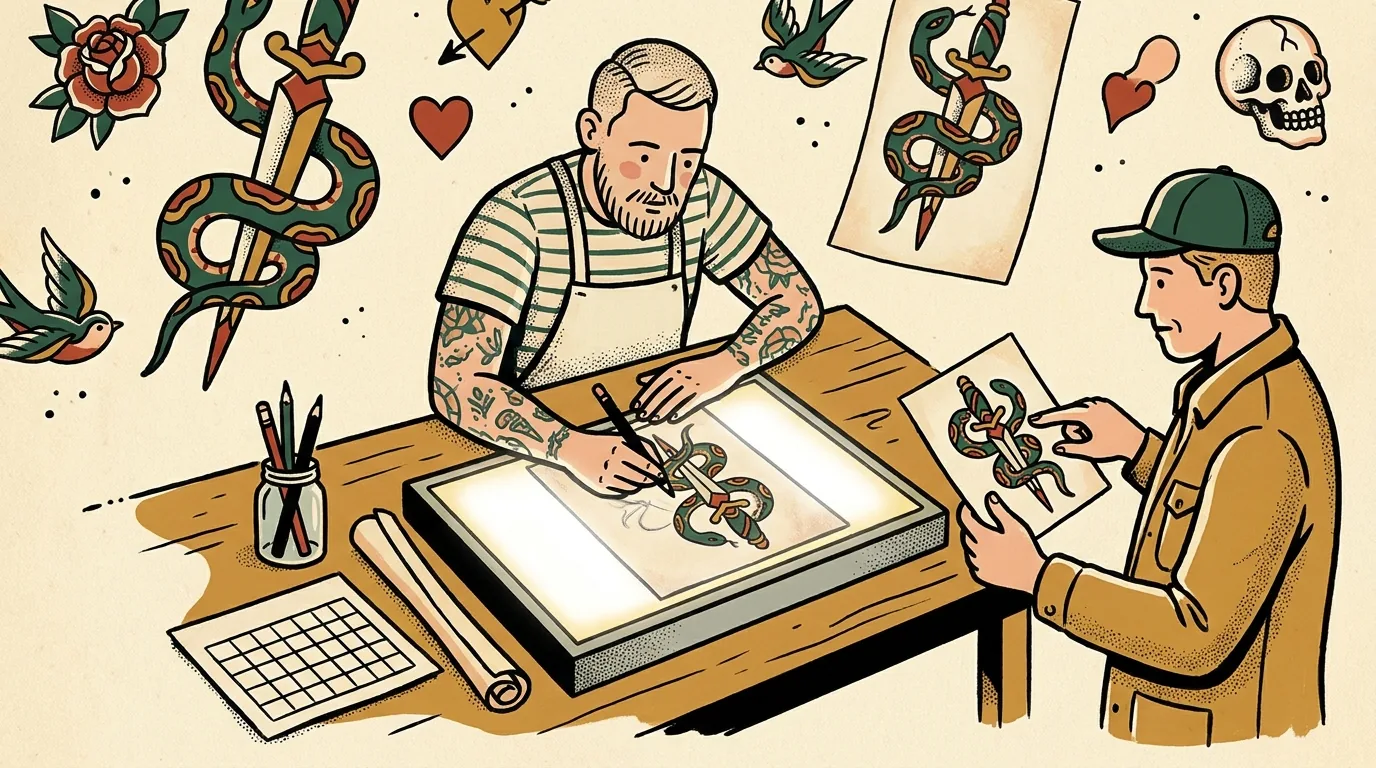
Walk-ins work for flash and small pieces. Anything custom, large or detailed usually needs a booking. That process differs from artist to artist, but the steps are similar almost everywhere: you send a request, you talk through the idea, you pay a deposit to hold a date, and the artist draws your design.
How to book
Artists take booking requests in different ways. Check the shop’s website or the artist’s profile for instructions before you send anything:
- A booking form on the shop’s or artist’s website. This is the most common for custom work.
- Email or social media messages, when the artist says they take requests that way.
- Phone or in person at the front desk.
Some popular artists open their books only at certain times and announce it on social media. If an artist’s books are closed, wait for the next opening rather than sending repeated messages.
What to send
A clear request gets a faster, better reply. Include:
- The idea in a few sentences: subject, mood and any must-have elements.
- Size in inches, roughly.
- Placement, with a photo of the area if the form asks for one.
- Color or black and grey.
- A few reference images, with a note on what you like about each. A handful is more useful than dozens.
- Existing tattoos nearby, if the new one needs to fit around them. For a cover-up, include clear photos of the old tattoo; see cover-up tattoos, explained.
- Your availability and, if you have one, your budget.
The consultation
A consultation is a conversation about your tattoo before it’s drawn. It may be a short visit to the shop, a video call, or a back-and-forth by message. Some artists skip a formal consultation for smaller pieces and handle everything in the booking form.
In person, the artist may look at the placement, measure the area and talk about how the design will flow with your body. This is your chance to see whether you work well together.
Questions worth asking
- How do you price this? Artists charge by the hour, by the piece, or by the session. Ask for an estimate and whether it could change if the design grows.
- How many sessions will it take? Large or detailed pieces often take more than one, with healing time between.
- How much is the deposit, and what are the terms? Ask what happens if you need to reschedule or cancel.
- When will I see the design? Many artists show it on the day; some send it ahead.
- How many changes can I ask for? Small tweaks on the day are normal. A full redraw may cost extra or need a new date.
- What is your touch-up policy?
- How do you wrap tattoos, and what aftercare do you recommend? See our aftercare guide.
It’s also fine to ask the hygiene questions in how to choose a tattoo artist.
Listening to the artist
A good artist will tell you if something won’t work well, such as tiny detail that may blur, a design that fights the shape of the body, or a placement that will be hard to heal. That’s experience talking, not upselling. Be open to their suggestions. You hired them for their eye.
Most artists won’t copy another artist’s tattoo exactly. Use other tattoos as references for style and mood, and expect an original design.
How deposits usually work
Once you agree on the idea and a date, the artist asks for a deposit. Common practice:
- It holds your date. The artist blocks off that time for you and turns other clients away.
- It covers drawing time. Custom design work happens before you sit down, often unpaid without a deposit.
- It goes toward the price. The deposit is usually subtracted from the cost of the tattoo, often from the final session of a multi-session piece.
- It’s usually non-refundable. If you cancel late or don’t show up, you typically lose it.
- Rescheduling is often allowed with enough notice, sometimes a limited number of times.
Every shop sets its own terms. Read them before you pay, and keep the receipt, email or message that confirms the amount, the date and the policy.
Avoiding deposit scams
Fake accounts sometimes copy a real artist’s photos and message people offering quick appointments for a deposit. To protect yourself:
- Book through the shop’s official website, its listed phone number, or the artist account linked from the shop’s own site.
- Be wary of accounts that message you first, offer an unusually fast slot, or push you to pay right away.
- Check the account’s history: a new account with copied photos is a warning sign.
- If in doubt, call the shop on the number from its website or Google listing and confirm before paying anything.
Before the appointment
- Confirm the date and time a day or two ahead.
- Get a good night’s sleep and eat a full meal before you go. See the tattoo pain chart for ways to make a session easier.
- Bring a valid photo ID and the rest of the payment, plus a tip. See how much to tip a tattoo artist.
- Wear clothes that give easy access to the placement.
On the day
The artist shows you the design and places a stencil. Look at it in a mirror and check size, angle and spelling. Small adjustments are normal at this stage; speak up before the tattooing starts.
If you need to cancel
Life happens. If you can’t make it, tell the shop as early as possible. Early notice often lets you keep your deposit and lets the artist give the slot to someone else. A no-show without a message leaves the artist with an empty chair and time they can’t get back.
Not ready to book? Many shops tattoo flash and small pieces without an appointment. See walk-in or appointment? and the walk-in tattoo shops pages. To find an artist for a style, start at shops by style or shops by state.
Common questions
- Are tattoo consultations free?
- Many are, especially short ones or consultations done by message. Some artists charge for a consultation or fold it into the deposit. Ask when you book.
- Is a tattoo deposit refundable?
- Usually not. Most deposits are non-refundable but go toward the price of the tattoo, and many shops let you reschedule with enough notice and keep the deposit. Read the shop’s terms before you pay.
- Will I see the design before my appointment?
- It depends on the artist. Many show the final design on the day of the appointment and make small changes then; some send it ahead. Ask at your consultation.
- How do I avoid a tattoo deposit scam?
- Book through the shop’s official website, phone number or the artist account linked from it. Be wary of accounts that message you first offering a quick slot, and confirm with the shop by phone before paying a deposit to anyone you don’t know.